SOME THINGS YOU PROBABLY DIDN’T KNOW ABOUT NASAL BREATHING
BY RACHEL GARROD

Did you know that the nose is part of the respiratory system? The nose should be our predominant method of inhaling and exhaling air, and there are sev eral good reasons for this. The nostrils, hair and nasal passageways are de signed to assist in filtering allergens and foreign bodies from entering the lungs. When we breathe through our mouth, we are directly inhaling any particles or pollutants from the air, but with nasal breathing larger particles are trapped by tiny hairs in the passages and smaller ones by the mucus membranes. The nose also slows the velocity of the air we inhale, which maximises exposure to small arteries and lymphatics. Because nose breathing creates increased resistance to the air compared with mouth breathing, oxygen uptake is in creased – by as much as 20 per cent. When we breathe through the nose we increase levels of carbon dioxide in the blood. This important gas facilitates the release of oxygen from red blood cells to tissues and organs where it is needed. Another essential gas, nitric oxide, is produced in the nose and in the para nasal sinuses. Nitric oxide is crucial to respiratory health as it helps keep our small airways open and is known for its protective effect on the heart. When we inhale through our nose, we transport this gas throughout the body. Nitric oxide is considered to prevent – and even reverse – heart disease.
All in all, nasal breathing is an essential component for health. Unfortunately, 30 to 50 per cent of adults are mouth breathers, which causes several health problems such as snoring, sleep apnea, and speech and swallowing issues. The first step to improving your breathing is awareness. A conscious effort is required to change from mouth breathing to nose breathing but it is possible. In some cases, nasal irrigation can help clear a blocked nose, but if there are structural problems such as a deviated septum this might need surgery. For most people, however, simple breathing retraining exercises can do the job and can be easily taught by respiratory physiotherapists. Yoga breathing techniques, known as Pranayama, utilise a conscious focus on breathing and generally encourage nasal breathing. But there are some “Breathwork” sessions which advocate prolonged pe riods of mouth breathing, leading to a dangerous state of hyperventilation (over-breathing), which can cause painful muscle spasms or fitting. Beware of these!
If you want help with your breathing, get in touch with Rachel Garrod (Ph.D. Physiotherapist): rachelgarrod1@gmail.com Tel. (+34) 699 501 190 www.betterbreathingphysio.com
AN AVOCADO A DAY MAY KEEP HEART DISEASE AT BAY
MEDICAL MINUTES BY JOHN SCHIESZER
Replacing cheese or mayonnaise with an avocado may be a great new way to improve your overall diet. A new study has found that eating two or more servings of avocado weekly is associated with a lower risk of cardiovascular disease, and substituting avocado for certain fat-containing foods like but ter, cheese or processed meats is associated with a lower risk of cardiovas cular disease events. Avocados contain dietary fibre, unsaturated fats, especially monounsatu rated fat (healthy fats), and other favourable components that have been associated with good cardiovascular health. Clinical trials have previous ly demonstrated that avocados have a positive impact on cardiovascular risk factors including high cholesterol. A medium avocado contains about 12 grams of fibre. The recommended amount is 28 to 34 grams of fibre per day. “Our study provides further evidence that the intake of plant-sourced un saturated fats can improve diet quality and is an important component in cardiovascular disease prevention,” said lead study author Lorena S. Pache co, a postdoctoral research fellow at the Harvard T.H. Chan School of Public Health in Boston. “These are particularly notable findings since the consump tion of avocados has risen steeply in the US in the last 20 years, according to data from the U.S. Department of Agriculture.” For 30 years, researchers followed more than 68,780 women (ages 30 to 55 years) from the Nurses’ Health Study and more than 41,700 men (ages 40 to 75 years) from the Health Professionals Follow-Up Study. All the participants were free of cancer, coronary heart disease and stroke at the start of the study. Researchers documented 9,185 coronary heart disease events and 5,290 strokes during more than 30 years of follow-up. They assessed participants’ diet using food frequency questionnaires given at the beginning of the study and then every four years. They calculated avocado intake from a ques tionnaire item that asked about the amount consumed and frequency. One serving equalled half an avocado or a half cup of avocado. After considering a wide range of cardiovascular risk factors and overall diet, study participants who ate at least two servings of avocado each week had a 16 per cent lower risk of cardiovascular disease and a 21 per cent lower risk of coronary heart disease, compared to those who never or rarely ate avocados. Based on statistical modelling, replacing half a serving daily of margarine, butter, egg, yoghurt, cheese or processed meats such as bacon with the same amount of avocado was associated with a 16 per cent to 22 per cent lower risk of cardiovascular disease events. The study aligns with American Heart Association guidance to follow the Mediterranean diet, which focuses on fruits, vegetables, grains, beans, fish and other healthy foods and plant-based fats such as olive, canola, sesame and non-tropical oils. “These findings are significant because a healthy dietary pattern is the cor nerstone for cardiovascular health,” said Cheryl Anderson, chair of the Ameri can Heart Association’s Council on Epidemiology and Prevention. “However, it can be difficult for many Americans to achieve and adhere to healthy eating patterns.”. This research complements and expands current literature on plant-sourced unsaturated fats and heart disease. These findings further substantiate evi dence on the replacement of certain spreads and saturated fat-containing
foods such as cheese and processed meats, with a plant-sourced fat such as avocado, which, for the most part, is a well-accepted and popular food. Pacheco noted that avocados are readily available and can be included as part of a healthful diet as a spread or dressing, or even a dipping sauce. You can use the serving size of one-half cup of avocado (approximately 80 grams) and add it to salads, or as a spread on a sandwich in lieu of mayon naise, or mix it with cilantro and lime juice as a dressing or dipping sauce with some raw veggies. Avocados can also be included in a smoothie instead of yoghurt.
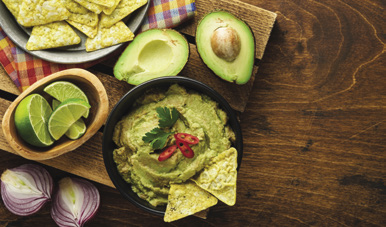
Don’t Go Overboard with the Guacamole If you are following a medication regimen, Pacheco said you should first check-in with your physician and nutritionist before consuming large amounts of avocado. “In the case of avocados, these contain vitamin K, which is a blood clotting nutrient that may decrease the effect of blood-thinning med ications like warfarin, so if you are on warfarin you need to consider this.” Avocados are also rich in potassium so someone on a low potassium diet needs to talk to their healthcare provider before including them in their diet. “Lastly, and slightly beyond the potential food-drug interaction, those indi viduals with a latex sensitivity or allergy should avoid avocados since some proteins in latex that cause latex allergy are also present in avocados, and in other fruits such as bananas, kiwis and strawberries to name a few,” said Pacheco. While avocados are a nutrient-rich food item with favourable food com pounds including monounsaturated and polyunsaturated fats, they also are a calorie-rich food item. Pairing avocados with chips may compromise the benefits. “In most cases, when you have guacamole or similar spreads, it is easy to over-consume them, increasing your overall calories. Besides this, most of us do not pay attention to the serving size on the bag of chips and keep ‘munching away’, making this a troublesome combination,” said Pa checo. John Schieszer is an award-winning national journalist and radio and pod cast broadcaster of The Medical Minute. He can be reached at medicalminutes@gmail.com.